.jpg)


The Face of a Dinosaur - Notes on the African Ground Hornbill
- carlgroombridge71

- Aug 26
- 9 min read
A short meditation on the African ground hornbill — its beauty, origin, and behaviour, and what it asks of the collections that keep it.
By Carl Groombridge ACFE, Animal Insights Consultancy Ltd Photographed and filmed at Linton Zoo Conservation Park, Cambridgeshire
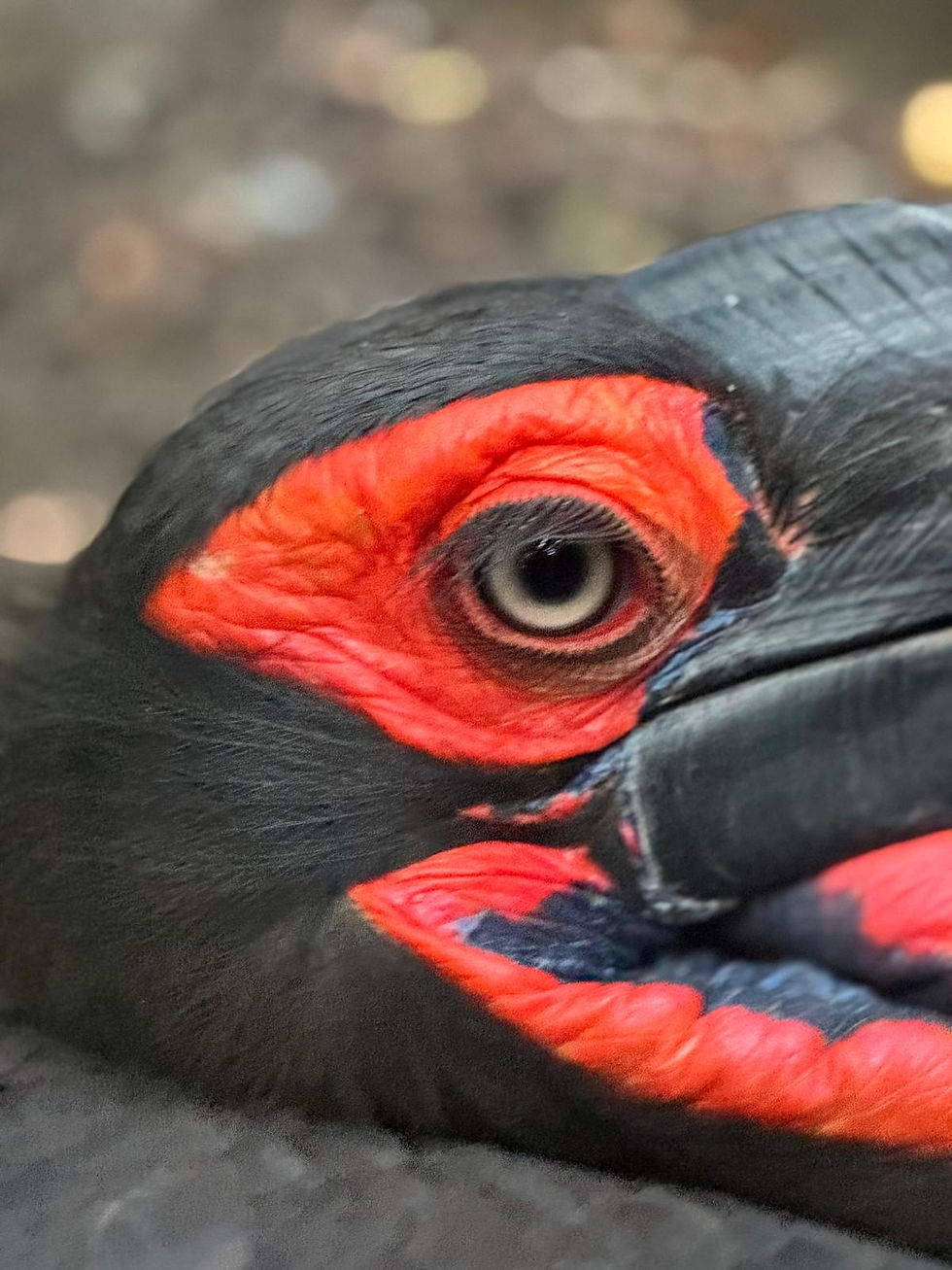
File: hornbill-face.jpg Caption: A face that seems assembled from another era — jet-black plumage, bare crimson skin, and a pale, unblinking eye ringed with feather-lashes. Photographed in the hornbill collection at Linton Zoo Conservation Park, Hadstock Road, Linton, Cambridgeshire CB21 4NT, UK. Alt text: African ground hornbill (Bucorvus leadbeateri) photographed at Linton Zoo Conservation Park, Cambridgeshire
There is a particular kind of beauty that does not flatter. It does not soften itself for the viewer, and it does not ask to be liked. The face of the African ground hornbill — the southern ground hornbill, Bucorvus leadbeateri — is of that kind. Looking at this photograph, taken a few feet away through the mesh at Linton Zoo in Cambridgeshire, I am struck again by how prehistoric it appears: a black, armoured head; a great down-curved bill like a blacksmith’s tool; and that extraordinary bare skin, flushed red as though the bird is quietly furious about something. The pale eye, set in the crimson, stares back with an intelligence that feels older than mine. I keep returning to this image because it refuses to become ordinary.
Beauty
What first arrests the eye is the contrast. Against the sooty black of the feathers, the bare facial skin burns a deep, wet red — the colour of raw earth after rain, of embers, of something alive beneath the surface. Long, lash-like feathers frame the eye, giving the bird an unexpectedly soulful expression, almost reproachful. The bill, enormous and decurved, is the engine of the whole face: ivory at the base deepening to black at the tip, scored with use. It is not a “pretty” animal in any gentle sense. It is magnificent in the way a cathedral door or a weathered cliff is magnificent — by mass, by detail, by the sense that nothing about it is accidental.
Look closer and the face tells you the bird’s story. That bare red skin is a signal board. In a male, the throat and face are wholly red; in a female, a patch of violet-blue breaks the crimson just below the bill — a single quiet mark of difference. During the breeding season the male can inflate that fleshy throat, the wattle swelling like a bellows, and from it comes one of the great sounds of the African bush: a deep, resonant booming that carries for a mile or more and is so low and vast that it is regularly mistaken for the roar of a lion. Beauty, here, is not silent. It thunders.
Origin
The southern ground hornbill is a child of the African savanna. Its range reaches across the southern third of the continent — from Kenya and Tanzania down through Zambia, Zimbabwe, Mozambique, Botswana, and into South Africa — wherever there are open woodlands and grasslands studded with the big trees it needs for nesting. It is, by a comfortable margin, the largest of all hornbills: standing some three feet tall, with a wingspan that can reach six feet, and weighing up to fourteen pounds in a dominant male. To watch one walk is to understand the name. It does not flit. It strides, slow and deliberate, across the ground it plainly regards as its own.
Evolutionarily, the ground hornbills sit on an old branch of the family tree, set apart in their own genus and, with their northern cousin Bucorvus abyssinicus, in a subfamily all to themselves. They are the walking dinosaurs of the savanna, and looking into that ancient face one can believe it. Yet that long lineage is now precariously balanced. The IUCN lists the species as Vulnerable, and the news is not improving. Logging, agricultural expansion, and the loss of the large cavity-bearing trees where they nest have eroded the bird’s world; researchers estimate its original range in South Africa has shrunk by two-thirds over the past century, and by roughly a fifth in just fifteen years. Pesticides, persecution — the birds are poisoned for traditional uses, or killed when they attack their own reflections in windows — and their own achingly slow breeding rate compound the pressure. This is an animal built to outlast empires, struggling to outlast a century.
Behaviour
If the face is the hook, the life is the reason to stay. Southern ground hornbills are social in a way that feels almost human. They live in cooperative groups of two to eleven birds — typically a dominant breeding pair and a retinue of helpers, mostly male, who are often the pair’s own grown offspring. Only the alpha pair breeds; the rest defend the territory, guard the nest, and help raise the single chick that usually survives each nesting attempt. They are, in other words, a family business, and a patient one: a dominant pair may breed only once every several years, laying two eggs from which, almost invariably, only one fledgling emerges.
The group moves together on foot, foraging through the grass with a slow, methodical gait, those great bills working like tongs — snapping up insects, frogs, lizards, and snakes, including venomous ones, which the long bill lets them dispatch at a safe distance. They will take tortoises, hares, squirrels, and even small primates; they have been seen grooming parasites off warthogs. When they are not hunting, they are calling — those booming choruses that mark the borders of their territory, audible a mile off, answered by neighbouring groups in a kind of long-distance diplomacy of sound. They are non-migratory, faithful to a patch of country and to each other, and long-lived: thirty to forty years in the wild, and in managed care sometimes sixty years or more. To know one is, quite possibly, to know it for most of a human lifetime.
Seen for Yourself — Two Moments at Linton
Description only goes so far with an animal like this, so here are two short films taken at Linton Zoo Conservation Park. Together they capture the two halves of the bird’s character: the surprising aerialist, and the patient forager.
File: hornbill-canopy-flight.mp4 (0:29) Upload via: Wix Blog editor → + → Video → Upload from computer
Up in the canopy. For a bird so firmly associated with the ground, the ease with which it takes to the treetops is startling — a heavy body moving through green shade, then the broad-winged drop from branch to branch. In the wild these birds roost in tall trees at night and nest in cavities high in mature timber, so vertical space is not a luxury in a habitat like this. It is a behavioural necessity, and a well-planted, generously tall aviary is what makes it possible.
Filmed at Linton Zoo Conservation Park, Cambridgeshire.
File: hornbill-enrichment-woodchip.mp4 (1:12) Upload via: Wix Blog editor → + → Video → Upload from computer
Mooshing through the woodchip. This is enrichment doing exactly what enrichment should: not a novelty object, but a deep, varied substrate of woodchip, leaf litter and loose timber that rewards the bird’s own natural search behaviour. Watch the method — the bill used as tongs, flicking and turning the chippings, the head tilting to listen and look, the unhurried working of one patch before moving to the next. This is the same motor pattern a wild group would use crossing a stretch of savanna grass, and here it fills the hours that an empty floor would leave idle.
Filmed at Linton Zoo Conservation Park, Cambridgeshire.
What I find quietly persuasive about these two clips, watched back to back, is how much of the wild bird survives in them. Nothing here is a trick or a performance. It is a species doing what it evolved to do — climbing, scanning, probing, turning over the world with that extraordinary bill — because the habitat gives it the room and the raw material to do so. That is the whole argument for good husbandry in a single minute of footage.
I admire this bird the way I admire a piece of living architecture — for its refusal to be reduced, for the way it carries an entire ancient world in the set of its shoulders and the gleam of that impossible red face. Every photograph I take of one feels like a small act of gratitude.
Captive Care — and a Cambridgeshire Connection
Given all of this — the size, the longevity, the social complexity, the glacial reproduction — keeping ground hornbills in animal collections is a serious undertaking, and rightly so. These are not birds that tolerate a small aviary and a bowl of seed. Collections that hold them, working within coordinated regional breeding programmes, must account for a great deal: generous, naturalistic enclosures that allow ground foraging and enough vertical space for flight; stable, compatible social groupings that mirror the cooperative structure of wild flocks; and a varied carnivorous diet that approximates the breadth of their wild intake, from invertebrates to small vertebrates.
Nesting is the crux. In the wild the birds depend on large natural cavities in mature trees — a resource that is itself disappearing — so collections must provide robust, secure nest sites, often custom-built, and manage the reproductive biology carefully. Because a group typically rears only one survivor per clutch, the second-hatched chick is sometimes hand-reared by experienced keepers for potential reintroduction, a practice central to field recovery efforts such as South Africa’s Mabula Ground-Hornbill Project.
Which brings me back to where these films were made. Linton Zoo Conservation Park, on Hadstock Road just outside Linton in Cambridgeshire, describes itself as Cambridgeshire’s wildlife breeding centre — and it is a genuinely old-fashioned virtue of the place that it is built around breeding rather than spectacle. A BIAZA member, its collection runs from Mexican red-kneed tarantulas and giant tortoises through toucans, parrots, owls and pheasants to snow leopards, Amur tiger, Hartmann’s mountain zebra and Brazilian tapir — and, notably for me, a fine group of hornbills, the great hornbills among them. Many of the species held there form part of international captive breeding programmes.
Standing in front of that enclosure on a grey English afternoon, several thousand miles from any savanna, I found the encounter unexpectedly moving. A well-run collection like this becomes more than an exhibit: it is an ark, a research station, and a classroom, holding the line for species whose wild futures are uncertain — and giving visitors like me the chance to stand a few feet from that extraordinary face and understand exactly what stands to be lost.
This is the part of the work that keeps me in it. Through Animal Insights Consultancy I spend my working life on precisely the questions this bird raises — how a living habitat should be designed and planted, how records and breeding recommendations are managed through ZIMS and good registrar practice, how signage turns a glance into understanding, and how keeper teams are trained and motivated to deliver it day after day. A species like the ground hornbill is an unusually honest test of all of it. Get the space, the social group, the diet, the nest site and the record-keeping right, and the birds tell you so. Get them wrong, and a bird that should live sixty years quietly fails to thrive.
At a glance — southern ground hornbill
Species: Bucorvus leadbeateri — largest of all hornbills
Range: savannas and woodlands of southern and East Africa
Size: up to ~3 ft tall; wingspan 4–6 ft; 5–14 lbs
Social: cooperative groups of 2–11; only the dominant pair breeds
Reproduction: ~2 eggs, usually 1 survivor; may breed once every several years
Lifespan: 30–40 yrs wild; up to 60+ yrs in managed care
Status: IUCN Vulnerable — population decreasing
Sound: deep booming call, audible ~1 mile, often mistaken for a lion’s roar
Photographed at: Linton Zoo Conservation Park, Cambridgeshire, UK
To photograph one is, for me, a kind of reverence. The bird does not perform for the lens; it simply exists, fully and without apology, and the camera only records what was already there. That is what I love about this species. It is not charming. It is not convenient. It is ancient, communal, loud, slow to reproduce, and unbearably beautiful, and the world is measurably richer for every group that still walks the savanna — and for every collection, Linton among them, that chooses to care for them well.

Photo credit and where to see them
Linton Zoo Conservation Park — Cambridgeshire’s wildlife breeding centre. Hadstock Road, Linton, Cambridgeshire, CB21 4NT, United Kingdom Tel: 01223 891308 · lintonzoo.co.uk · Facebook
All photography and video in this post was taken on site at Linton Zoo Conservation Park and is reproduced here with the collection credited. If you share or republish this image or footage, please retain the credit.
About the author
Carl Groombridge ACFE is the director of Animal Insights Consultancy Ltd — fulfilling the niche in the world of animals — with 35+ years of hands-on zoological experience guiding collections with compassion, integrity and uncompromising welfare standards.
The consultancy supports zoos, wildlife parks, open farms and private collections across the UK with licensing and inspection readiness, bioactive and living-habitat design, Species360 (ZIMS) record management, health and safety, interpretive signage, and keeper-team CPD.
Services · Projects · Case studies · Gallery · Blog and media · About Carl
contact@animalinsightsconsultancy.com · 07971 550 320 · Book a free consultation
Sources and further reading
Linton Zoo Conservation Park — lintonzoo.co.uk (where the photograph and films were made)
National Geographic — Southern ground-hornbill, facts and photos
ZooTampa at Lowry Park — Southern Ground Hornbill (Bucorvus leadbeateri)
Mabula Ground-Hornbill Project — ground-hornbill.org.za
IUCN Red List — Bucorvus leadbeateri assessment
San Diego Zoo Wildlife Alliance — Southern Ground Hornbill Fact Sheet


Comments