.jpg)


Leading on Welfare what WAZA's New Strategy Asks of Zoos and Aquarium Managers

WAZA's 2025 Annual Report marks the Association's 90th anniversary year. For anyone running a zoo or aquarium, one milestone deserves a place on the next senior team agenda: the updated World Zoo and Aquarium Animal Welfare Strategy, Advancing Animal Welfare.
It replaces the 2015 edition and reflects a decade of scientific progress, shaped by 45 contributors from 35 organisations. Its central expectation is simple, and it matters for leaders: animals in our care should have mostly positive experiences, and that has to be planned for, resourced and shown.

Welfare is now a whole-organisation responsibility
The biggest shift for managers is scope. Welfare is no longer something that sits with the animal team alone. The strategy expects it to run through every part of operations: capital projects, visitor experience, events, procurement, staffing and communications. It also covers all animals in your care, from the flagship species to the back-of-house collections.
In practice, welfare decisions now belong in the boardroom as much as the keeper's room.
Five questions every manager should be asking:
1. Do we formally assess the welfare of every animal? A consistent, recorded assessment programme is the foundation. If it's patchy or species-limited, that's your first priority.
2. Do assessment results actually drive decisions? The strategy is clear that evidence should guide where time, budget and space go. Can you show where welfare findings have changed a plan?
3. Is welfare built into capital and habitat projects from day one? It's far cheaper to design for choice, control and natural behaviour than to retrofit later.
4. Are our people equipped and empowered? Welfare is delivered by staff. Training, clear responsibilities, and a culture where keepers feel confident raising concerns are management responsibilities.
5. Are we telling our welfare story with confidence? The strategy encourages collections to share the good they do for animals. Done well, that builds visitor trust, supports funding bids and strengthens your reputation.
Making it work in the real world
Every collection has limits: budget, space, staffing and legacy infrastructure.
The strategy doesn't expect overnight transformation.
It expects clear direction, honest assessment and steady, evidence-led progress. The organisations that do best are the ones where leaders set the tone and give their teams the tools to deliver.
How I can help
How does your organisation measure up?
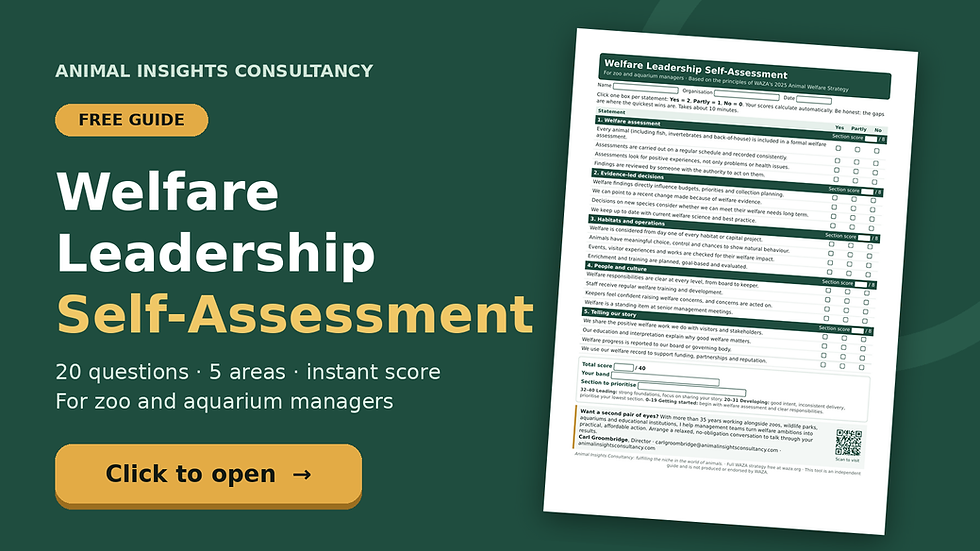
A strategy only makes a difference when it reaches the animals, the keepers and the decisions made every day. To help managers turn WAZA's 2025 Animal Welfare Strategy into practical action, I've created a free Welfare Leadership Self-Assessment. It has 20 straightforward statements across five key areas: welfare assessment, evidence-led decisions, habitats and operations, people and culture, and telling your story. It takes about 10 minutes, scores itself, and shows your strengths and where to focus first. Your answers are for your eyes only, so be honest: the gaps are where the quickest wins are. Once you have your results, if you'd value a fresh, independent view, arrange a relaxed, no-obligation conversation.
Click the image below to open the self-assessment.
Over more than 35 years working with zoos, wildlife parks, aquariums and educational institutions, I've helped management teams turn welfare ambitions into practical, affordable action. That includes welfare assessment frameworks, habitat design, husbandry reviews, licensing, staff development and collection planning.
If you'd like a fresh, independent view on how your organisation lines up with the new strategy, arrange a relaxed, no-obligation conversation.
Animal Insights Consultancy: fulfilling the niche in the world of animals.
Visit animalinsightsconsultancy.com to find out how I can help your organisation.
The full strategy is free to download from WAZA: waza.org/priorities/waza-code-of-ethics/animal-welfare-strategies


Comments