


From Minimum Compliance to Thriving Lives: Operationalising the Five Domains Model and Living Habitats in Modern Zoos

For decades, the zoological sector relied on the Five Freedoms as the benchmark for captive animal care. Formulated primarily for agricultural contexts in the mid-1960s, the Five Freedoms focused on what an animal should not experience: hunger, thirst, discomfort, pain, disease, and distress.
While essential as a baseline, modern animal welfare science has evolved. The upcoming revision of Great Britain’s Standards of Modern Zoo Practice (SSSMZP), coming into statutory force on 24 May 2027, joins global frameworks from the World Association of Zoos and Aquariums (WAZA) and the European Association of Zoos and Aquaria (EAZA) in demanding something more ambitious: an institutional shift from mere cruelty prevention to the promotion of positive welfare states.
To pass future licensing audits and maintain public trust, animal collections must move beyond sterile, clinical management. Doing so requires integrating the Five Domains Model with living, bioactive habitat design and verifiable record-keeping.
The Evolution: Why the Five Freedoms No Longer Suffice
The Five Freedoms assume that welfare is neutral when negative experiences are absent. However, modern ethology demonstrates that an animal in a sterile, disease-free concrete enclosure can still suffer from chronic boredom, apathy, and cognitive deprivation.
Professor David Mellor and colleagues formulated the Five Domains Model to provide a systematic framework for evaluating animal wellbeing. Unlike the Five Freedoms, the Five Domains model recognises:
1. Nutrition: Not just meeting caloric minimums, but offering ingestive choice, species-specific foraging complexity, and varied food textures.
2. Physical Environment: Providing thermal, tactile, olfactory, and lighting gradients rather than static parameters.
3. Health: Balancing disease management with musculoskeletal fitness, functional locomotion, and natural wear patterns.
4. Behavioural Interactions: Affording autonomy, agency, social complexity, and goal-directed challenges.
5. Mental State (Affective Experience): The cumulative outcome of the first four domains, translating physical inputs into positive emotional states such as curiosity, playfulness, comfort, and satiety.
Under the new SSSMZP guidelines, collections must demonstrate that their animals experience a life worth living, characterised by positive affective states.
Bioactive Husbandry: The Architectural Key to the Five Domains
One of the most practical, cost-effective ways to deliver on Domains 2, 3, and 4 is the transition from clinical enclosures to living, bioactive habitats.
Historically, quarantine mentalities dominated zoo design: cleanable tiles, concrete pads, and artificial furnishings. While intended to break parasite cycles, these sterile biomes often stripped animals of sensory feedback and agency.
A true bioactive biome incorporates living subsoil layers, drainage strata, native microfauna (e.g., springtails, isopods, beneficial earthworms), and diverse botanical plantings. This approach benefits animal collections across three distinct areas:
1. Sensory Complexity and Agency (Domains 2 & 4)
In a bioactive biome, microclimates exist naturally. An ectotherm or small mammal can choose between high-humidity leaf litter, sun-dappled basking branches, or cool subterranean burrows. Giving animals the choice and control to regulate their own physiological state reduces stereotypic pacing and apathy.
2. Encouraging Natural Foraging and Physical Conditioning (Domains 1 & 3)
Insects and microfauna established within the soil create continuous, unpredictable micro-opportunities for exploration and foraging. Reptiles, amphibians, callitrichids, and ground-dwelling birds spend hours actively searching through leaf litter, promoting natural locomotion, digit wear, and cognitive engagement.
3. Establishing Stable Microbiomes (Domain 3)
Modern veterinary science increasingly mirrors human medicine regarding the importance of the microbiome. Studies demonstrate that animals housed on live biological substrates develop more resilient gut and skin microbiomes compared to counterparts housed on synthetic or frequently sterilised surfaces, reducing incidence of opportunistic bacterial and fungal infections.
Evidencing Compliance: Connecting Husbandry to ZIMS
A common stumbling block during local authority zoo inspections and association audits is not the quality of care, but the quality of evidence. A habitat may look progressive, but if curatorial teams cannot quantify welfare improvements, it remains anecdotal.
To satisfy licensing inspectors:
Record Behavioural Audits in ZIMS: Use Species360 ZIMS Care and Welfare modules to systematically log behavioural budgets (e.g., proportion of time spent foraging vs. resting vs. stereotypic behaviours).
Track Environmental Parameters: Log temperature gradients, UV index degradation, and substrate humidity cycles directly against animal health records.
Formalise Interaction Policies: If the enclosure interfaces with visitor feeding or encounters, document the animal's ability to withdraw at will, supported by quantitative behavioural observation before and after public sessions.
5 Questions Every Collection Manager Should Ask Ahead of 2027
To evaluate whether your habitats and husbandry protocols meet emerging standards, audit your exhibits against this checklist:
Does the animal have agency over its microclimate? Can it choose between distinct thermal, light, and humidity zones without leaving secure shelter?
Are behavioural opportunities continuous or episodic? Does stimulation rely solely on a scheduled daily keeper feed, or does the exhibit provide passive, ongoing enrichment?
What does the physical substrate promote? Does it allow for natural behaviours like digging, dust-bathing, wallowing, or rooting, or does it enforce static standing?
Is welfare monitored objectively? Are your keepers trained in ethogram-based behavioural observation, and is data reviewed regularly to adjust husbandry plans?
Can your documentation withstand inspection scrutiny? Can you produce dated welfare assessments and ZIMS records showing positive behavioural diversity across all seasons?
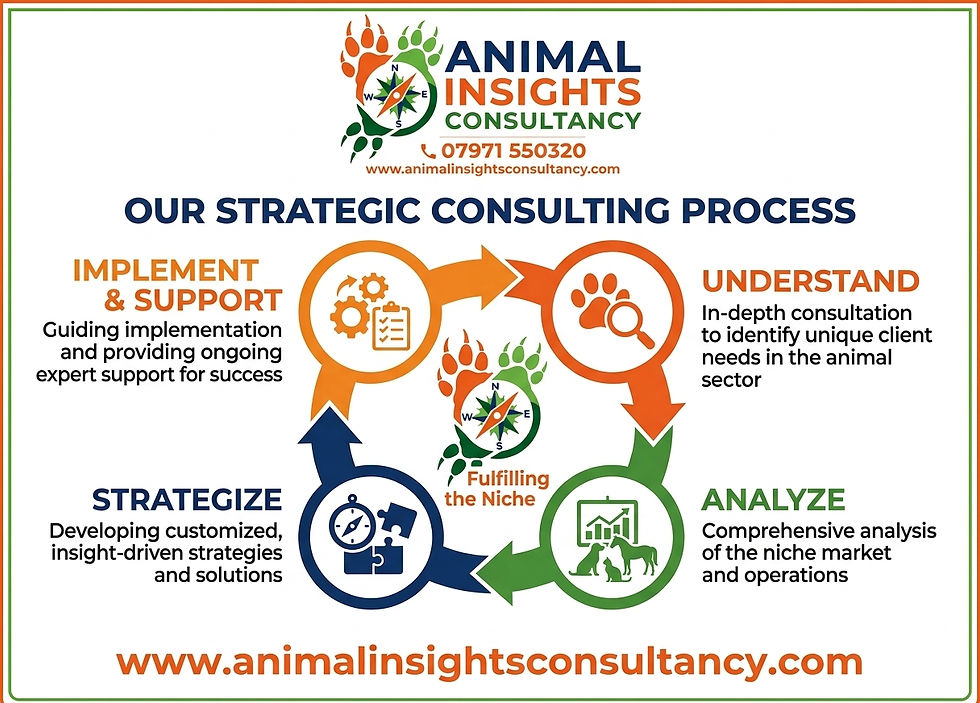
Animal Insights Consultancy outlines a strategic consulting process featuring four key steps: understanding client needs, analyzing niche markets, strategizing with tailored solutions, and implementing support for success, all aimed at fulfilling the niche in the animal sector.
Practical Next Steps
Upgrading legacy enclosures into bioactive living biomes and aligning husbandry audits with the Five Domains does not always require capital-intensive redevelopments. Often, significant gains can be achieved through clever retrofitting, substrate management, and structured record-keeping protocols.
Whether you are preparing an animal-management college for an inspection, auditing a wildlife park ahead of the 2027 Standards, or upgrading a nocturnal biome, practical, evidence-based guidance ensures your collection remains ahead of regulatory curves.
For an objective assessment of your habitats, welfare monitoring systems, or Species360/ZIMS records, contact Animal Insights Consultancy to schedule your initial consultation.
References & Citations
Farm Animal Welfare Council (FAWC). (1993). Second report on priorities in farm animal welfare research and development. Surbiton, UK: FAWC.
Department for Environment, Food & Rural Affairs (Defra). (2024). Standards of Modern Zoo Practice (SSSMZP) for Great Britain. London: Defra.
World Association of Zoos and Aquariums (WAZA). (2025). WAZA Animal Welfare Strategy: Caring for Wildlife. Gland, Switzerland: WAZA Executive Office.
Maple, T. L., & Perdue, B. M. (2013). Zoo Animal Welfare. Berlin: Springer Science & Business Media.
Mellor, D. J., Beausoleil, N. J., Littlewood, K. E., McLean, A. N., McGreevy, P. D., Dyson, S., & Harvey, A. M. (2020). The 2020 Five Domains Model: Including Human–Animal Interactions in Assessments of Animal Welfare. Animals, 10(10), 1870. https://doi.org/10.3390/ani10101870
Melfi, V. A. (2009). There are big gaps in our knowledge, and thus approach, to zoo animal welfare. Zoo Biology, 28(6), 574–588.
Breviglieri, B., et al. (2022). Environmental microbial diversity and the welfare of captive wildlife: The role of natural substrates in zoological biomes. Applied and Environmental Microbiology, 88(4), e01892-21.
EAZA. (2022). EAZA Standards for the Accommodation and Care of Animals in Zoos and Aquaria. Amsterdam: European Association of Zoos and Aquaria.

Comments