


Flexible, Committed, and Camera-Ready in the Modern Animal Workplace

A keeper can do everything right for ten quiet years, then one visitor clip can make their workplace look careless in ten seconds.

That is the reality now. Every enclosure is visible. Every interaction can be filmed. Every closed gate, warning sign, keeper instruction and animal reaction may be judged by someone who did not see what happened before the camera started rolling.
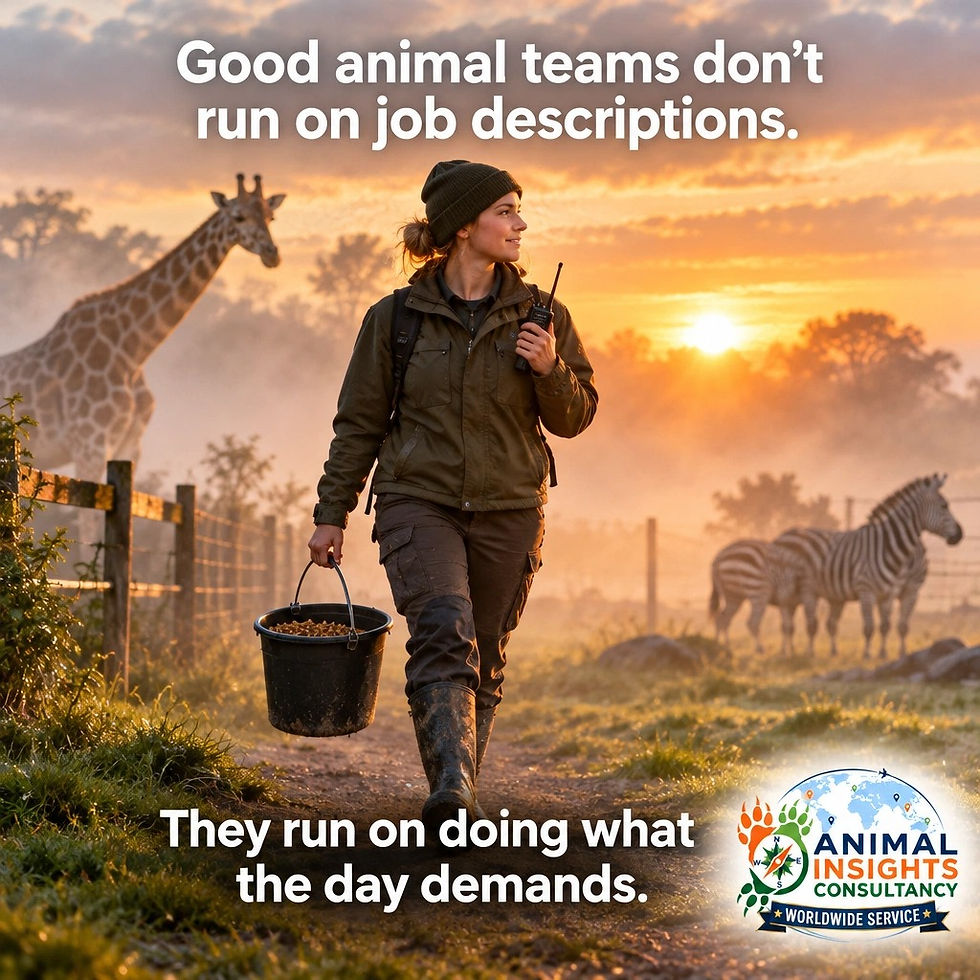
The animal workplace has always needed flexible, committed people. Early starts, late finishes, weekend rotas, last-minute cover, difficult weather, sick animals, public questions, education sessions and emergency calls are part of the job. Good animal teams have never run on job descriptions alone. They run on judgement, trust and the willingness to do what the day demands.
The difference now is that passion is no longer enough on its own. The modern animal establishment needs people who bring flair and energy, but also discipline, process and a clear understanding of risk. That applies around Category 1 species, of course. It also applies around goats, horses, parrots, pigs, reptiles, deer and every other animal that can injure a person when the wrong conditions line up.
The best teams are not only animal-ready. They are public-ready, camera-ready and policy-ready.

The modern animal workplace runs on flexibility with standards
Flexibility is one of the oldest requirements in animal care. Animals do not read rotas. Weather does not respect opening times. A team member may need to swap from feed preparation to fencing checks, from visitor engagement to assisting a vet, from routine cleaning to supporting a colleague after an incident.
That sort of flexibility is not casual. It is skilled.
A flexible animal team knows how to move without losing structure. They know which tasks can shift and which cannot. They know when to help, when to pause, when to ask, and when to follow a written procedure without improvising.
That matters because the public often sees only the visible part of the work. They see a keeper smiling during a talk, moving animals between areas, carrying enrichment or answering a child’s question. They may not see the risk assessment behind that moment, the briefing before it, the training record behind the member of staff, or the decision not to do something because conditions were not right.
A lively modern atmosphere is valuable. It helps staff feel involved. It makes education more engaging. It brings personality into a setting that can otherwise feel rule-bound. Flair matters, especially in public-facing animal work.
But flair must sit inside a clear framework.
The strongest workplaces make room for individuality without allowing personal style to replace policy. A keeper may have a brilliant way of explaining lemur behaviour to families. An education officer may bring real warmth to a school session. A presenter may have the gift of holding a crowd. That is all good. Yet none of it should blur the line on barriers, hand-feeding rules, animal contact, closed areas or keeper-only spaces.
A good culture does not ask people to choose between enthusiasm and discipline. It expects both.
That is especially true when teams are busy. A rushed day is when gaps appear. Someone props a gate. Someone assumes another person has checked the latch. Someone lets a visitor stand a little too close because the conversation feels friendly. Someone breaks a minor rule because “it will only take a second”.
Most serious problems do not begin with drama. They begin with drift.
Phone cameras have changed the public space around animal care
The phone camera has not created risk, but it has changed the speed and shape of it.
For years, animal establishments worked with public scrutiny through inspectors, local authorities, professional bodies, newspapers, campaign groups and visitor feedback. Those things still matter. Now there is another layer. A short clip can leave the site before a supervisor has heard the radio call.
That changes the job for everyone.
A keeper is not only carrying out a safe animal move. They may be doing it in front of a lens. A team member is not only asking a visitor to step back. They may be recorded by the visitor they are correcting. A member of staff is not only closing a public path during an animal issue. They may be challenged by someone who thinks transparency means full access to everything, at all times.
This is where training must become practical. Staff do not need to fear cameras. They do need to understand them.
They need to know:
what can be said confidently in public
when to call a supervisor
how to correct unsafe visitor behaviour without sounding hostile
how to avoid speculation during an incident
how to keep working safely when they know they are being filmed
how to document what happened while memories are fresh
The aim is not to stage-manage animal care. The aim is to make sure normal, professional work holds up under public attention.
That means tone matters. A sharp instruction may be necessary in a genuine safety moment, but contempt is dangerous. Public behaviour can be unreliable, unpredictable and sometimes reckless. That is true. Yet putting that frustration into the wrong words can damage trust.
A better way to frame it is this:
Visitor behaviour is variable, so safe systems must assume that some people will misunderstand, ignore or challenge instructions.
That sentence is firm without insulting the public. It recognises reality. Most visitors are not trying to cause harm. Some are distracted. Some are excited. Some are anxious. Some think rules are optional. Some want a better photograph. Some have seen too many misleading animal clips online and believe they understand an animal’s body language better than the staff do.
Policy must be built for all of them.

Category 1 thinking should improve the whole site
Category 1 species naturally sharpen attention. They should. Large carnivores and other high-risk animals demand strict controls, specialist skills and a workplace culture that does not tolerate shortcuts.
Secure working, lock checks, stand-off barriers, emergency drills, controlled access, clear communication and staff competency are not optional extras around high-risk species. They are the foundation of safe management.
The mistake is to treat those standards as belonging only to the most visibly dangerous animals.
A horse can kick with devastating force. A goat can knock over a child or an older visitor. A pig can bite. A deer can injure someone with antlers or hooves. A rhea, crane or swan can become a serious risk in the wrong setting. Small primates can hurt people and create disease-control concerns. Reptiles, birds, hoofstock, domestic species and invertebrates all carry their own forms of risk.
The public often ranks danger by drama. Big teeth, claws and venom feel dangerous. Familiar animals feel safe.
Animal professionals know better. Risk is not only about species. It comes from the full situation:
Animal factors
Human factors
Environmental factors
Task factors
Size, strength, temperament, breeding season, fear response, age, health and previous handling
Visitor behaviour, staff experience, fatigue, communication, confidence and distraction
Barriers, escape routes, noise, weather, footing, crowd density and visibility
Feeding, cleaning, moving, public contact, veterinary work, enrichment and emergency response
This is where Category 1 thinking can help the wider workplace. The discipline used around high-risk species can raise standards everywhere.
That does not mean every goat paddock needs the procedures of a big cat house. It means teams should use the same habit of mind. What could go wrong here? Who is exposed? What has changed today? What do we do if the public behaves in a way we did not expect? What does a new starter need to know before entering this space?
The best establishments avoid two dangerous extremes.
One extreme is complacency around familiar species. The other is theatre around dangerous ones. Neither keeps people safe. Professional animal work needs calm, consistent risk awareness across the whole collection.
Kit cards and clear routines turn judgement into habit
Good staff use judgement. Good workplaces do not leave everything to judgement.
That is where simple tools can be powerful. Kit cards, area checklists, radio protocols, daily briefings, written task instructions and role-specific competency records may not sound exciting, but they protect people. They also protect animals.
A “kit card” approach can work especially well because it turns a task into a quick visual check. Before a procedure begins, the team can see what equipment, people and permissions need to be in place. It reduces reliance on memory during a busy shift.
For example, a public animal contact session might require:
the named lead person for the session
the approved animals for that day
the correct handwashing or sanitising setup
clear start and stop times
barrier positions
visitor instructions
animal rest space
the stop conditions for ending the session early
The key is to keep tools short enough that staff use them. A bloated form becomes theatre. A clear card becomes habit.
Routines also support newer team members. The animal sector often attracts people with deep passion before they have deep experience. That is not a weakness. It is how many strong careers begin. But passion needs shaping.
A new staff member may be brilliant with visitors and keen to learn. They may also underestimate a familiar species, over-read a bond with an animal, or feel pressure to please the public. A written routine gives them something solid to stand on. It lets them say, “We do not do that here,” without making it personal.
That matters when visitors push boundaries.
A person may ask to touch an animal that is not part of a contact session. Someone may encourage a child to climb a barrier for a photograph. A regular visitor may say, “The other keeper lets us do it.” Someone may try to feed an animal despite signs. A camera may come out the moment a staff member intervenes.
Reliable systems make those moments easier.
The staff member is not inventing a rule. They are applying a site policy. The policy is not hidden in a folder. It is trained, repeated and backed by supervisors.
If a rule is worth having, it is worth supporting in public.

Upskilling should include public behaviour and not just animal skill
Animal knowledge is the heart of the work, but it is no longer enough on its own.
A modern animal establishment needs staff who can read behaviour on both sides of the barrier. They need to notice when an animal is becoming tense, and when a crowd is doing the same. They need to spot when a visitor is moving from curiosity to challenge. They need to adapt language for children, anxious adults, special educational needs groups, photographers, regular members and people who do not speak English as a first language.
This does not mean every keeper must become a polished presenter. It means public-facing skills deserve the same respect as practical animal skills.
Training should cover clear phrases for common situations. Staff should not have to invent wording in the heat of the moment.
Useful phrases might include:
“Please step back behind the barrier now.”
“That area is closed because we are moving animals.”
“I know it looks harmless, but feeding can make animals ill or unsafe.”
“For safety, we cannot allow touching unless it is part of a supervised session.”
“I can answer general questions, but I cannot comment on an active incident.”
These phrases are brief, direct and defensible. They also sound professional if recorded.
Training should also include escalation. A junior team member should know when to stop engaging and call for support. A confident keeper should not feel they must win a debate with a visitor while also monitoring an animal. Supervisors should be visible enough that staff believe backup will arrive.
The workplace culture decides whether that happens. If people are mocked for calling for help, they will delay. If staff feel unsupported after enforcing a rule, they may let the next breach slide. If management values visitor satisfaction over safety in the moment, the whole policy structure weakens.
Public-facing animal work needs a promise from leadership: if staff apply policy fairly, calmly and correctly, the organisation will stand behind them.
Transparency works best when boundaries are clear
Modern visitors often expect transparency, and that expectation is not unreasonable. Animal establishments should be able to explain what they do and why. Openness builds trust, especially when collections face questions about welfare, conservation, ethics and safety.
But transparency does not mean unrestricted access. It does not mean filming every staff-only area. It does not mean explaining an active animal health issue to a crowd in real time. It does not mean allowing visitors to ignore barriers because they want a better view.
Clear boundaries make transparency stronger, not weaker.
A site that explains its rules well looks confident. A site that appears to make rules up in the moment looks defensive. Signs, staff scripts, website information, pre-booking guidance and session briefings should all tell the same story.
For example, where public feeding is not allowed, the explanation should be simple. Feeding can harm animals, change behaviour, create aggression, disrupt diets and put visitors at risk. That is much stronger than “Do not feed the animals” on its own.
Where barriers are set back from an enclosure, explain that distance protects both animals and people. Where flash photography is banned in certain areas, explain the welfare reason. Where a path closes during animal movement, explain that staff need a safe working area.
The public does not need every operational detail. They do need enough explanation to see that rules are not arbitrary.
This approach also helps when something has gone wrong. A workplace that already communicates clearly is in a better position than one that only becomes visible during a crisis. The public has seen the standards before. Staff have practised the language. Managers know the process.
A camera-ready workplace is not one that performs safety. It is one that can show its safety culture because it already exists.
Recruitment should look for attitude as well as experience
Technical experience matters, but the modern animal workplace also needs the right temperament.
Flexible work can attract brilliant people. It can also burn them out if expectations are vague. Commitment can create strong teams. It can also slide into unhealthy pressure if staff feel they must always say yes. Flair can lift the visitor experience. It can also become risky if someone enjoys attention more than procedure.
Recruitment and probation should test for balance.
Strong candidates tend to show:
curiosity without overconfidence
warmth without boundary-blurring
confidence without ego
flexibility without carelessness
passion without drama
honesty about what they do not yet know
Interview questions can explore real judgement. Ask about a time they challenged unsafe behaviour. Ask how they would respond if a visitor filmed them while refusing to follow an instruction. Ask what they would do if a senior colleague skipped a check. Ask how they manage tiredness during long practical days.
The answers reveal more than animal enthusiasm alone.
Induction then needs to match the reality of the site. New team members should learn the animals, but also the public routes, radio language, emergency points, incident reporting methods, restricted areas, contact rules and escalation channels.
They should also learn the site’s tone. Some rules are legal or licence-related. Some are welfare-based. Some are operational. Some are there because experience has shown that people behave differently around animals than they do in other public spaces.
Good induction makes those reasons clear.
When staff understand the “why”, they apply rules with more confidence. When they only learn the “what”, they may bend rules under pressure.

A strong culture makes safety normal rather than dramatic
The safest animal establishments do not treat policy as a separate layer from daily work. They make it part of the rhythm.
Briefings are short but useful. Near misses are discussed without blame when possible. Repeated unsafe behaviour is dealt with firmly. Staff are encouraged to speak up. Managers listen when the people doing the work say a rule no longer fits the reality on the ground.
That last point matters. Discipline does not mean rigidity. A policy that cannot be questioned may become stale. Flexible workplaces should review procedures after changes in animal behaviour, enclosure design, visitor flow, staffing levels, weather patterns or public programming.
The goal is not to create a rule for every possible event. That would be impossible. The goal is to build people who can think clearly inside a shared system.
This is where the title’s three words meet.
Flexible means people can adapt to the day without losing the plot.
Committed means they take responsibility for animal welfare, team standards and visitor safety, even when no one is watching.
Camera-ready means their work is clear, consistent and defensible when everyone is watching.
None of this removes risk. Animals remain animals. People remain unpredictable. A collection can have excellent systems and still face difficult moments. But a strong culture reduces the number of avoidable incidents and improves the response when something happens.
It also protects the reputation of good work. The animal sector is full of skilled, dedicated people who care deeply about what they do. They deserve systems that support them, language that represents them well and leadership that does not leave them exposed when public behaviour becomes difficult.
The modern animal workplace needs warmth, skill and personality. It also needs firm lines, calm authority and repeatable process.
A goat paddock, a horse field, a reptile room and a Category 1 carnivore area do not carry the same risk. They should not be managed as if they do. But they all deserve serious thought, trained staff and a culture that refuses to confuse familiarity with safety.
Every visitor may carry a camera now. That should not make animal teams defensive. It should make them clear.
The work is already hard. The answer is not to drain it of energy or turn every interaction into a script. The answer is to build teams who can bring their whole selves to the job while still respecting the systems that keep people and animals safe.
That is the future of Flexible, Committed, and Camera-Ready in the Modern Animal Workplace: not fear of public scrutiny, but professional confidence in full view.


Comments