


Five Positive Lessons from Recent Zoo and Conservation Work

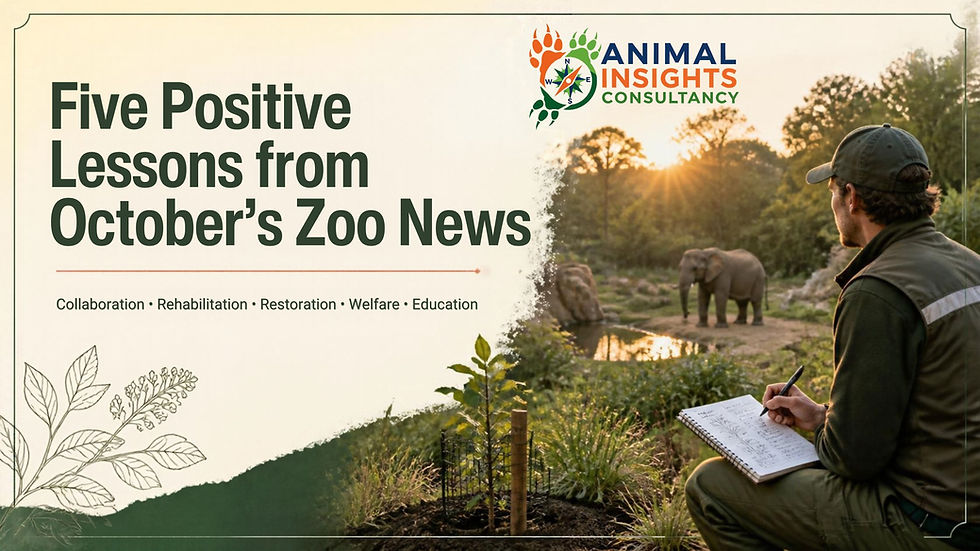
Good practice grows when the sector shares it. Recent announcements from zoos and conservation organisations show how collaboration, care and thoughtful leadership can create benefits well beyond one site.
Modern zoos and wildlife organisations do far more than care for animals within their own boundaries. They support rehabilitation, restore native species, improve welfare standards, influence public policy and help visitors understand how conservation works in practice.
Five recent announcements offer useful learning points for directors, curators, keepers, educators and trustees across the sector.
1. Collaboration turns good ideas into wider conservation impact
The Association of Zoos and Aquariums’ 2026 Conservation Grants Fund is supporting nine projects across different species and countries.
The projects include turtle head-starting, butterfly reintroduction, penguin monitoring, gibbon rehabilitation and threatened-species management. The important lesson is the way zoos, universities, government agencies, conservation organisations and field partners combine their expertise.
No single organisation needs to hold every answer. Strong partnerships can help smaller institutions contribute specialist knowledge, facilities, staff time, funding or public engagement.
Learning point: Look beyond traditional partnerships. A local university, wildlife charity, government body or community group may hold the knowledge that helps a zoo project go further.
Animal Insights Consultancy supports organisations with collection planning and practical zoological consultancy, helping teams connect welfare, conservation, education and operational priorities.
2. Rehabilitation works best as a journey, not a single event
The Columbus Zoo’s recent manatee transfers demonstrate the value of a coordinated rehabilitation network.
Rescued manatees moved between organisations according to their stage of recovery, with different facilities providing specialist care, veterinary support and preparation for a return to native waters.
This kind of work depends on clear communication, reliable records, consistent welfare standards and trust between organisations. Conservation success is often gradual. The release is important, but so are the rescue, assessment, transport, rehabilitation and monitoring stages that come before it.
Learning point: Review the whole animal-care pathway, from intake and quarantine through to rehabilitation, transfer, release and post-release monitoring.
Accurate records support every stage of that journey. Zoo Registrar support can help collections strengthen Species360, ZIMS and wider zoological record management.
3. Conservation can begin on the zoo’s own grounds
At the Bronx Zoo, 20 hybrid American chestnut trees have been planted as part of a wider restoration partnership.
The project connects the zoo’s history, horticulture team, local landscape and urban community with the recovery of a tree that was once widespread across North America.
Zoo grounds can support native plants, pollinators, wetlands, threatened trees and local wildlife. They can also become living classrooms where visitors see restoration taking place rather than simply reading about it.
Learning point: Ask what your own site can restore, protect or demonstrate.
For collections developing planted exhibits, tropical biomes or naturalistic enclosures, Living Habitats and Bioactive Husbandry offers practical support from early concept through to long-term husbandry.
4. Welfare improvement is an ongoing commitment
Loro Parque’s welfare recertification shows the value of maintaining high standards over time.
External certification is not a substitute for good daily care, experienced staff or strong leadership. It can, however, provide structure, independent scrutiny and reassurance that welfare commitments are being reviewed rather than treated as a one-off achievement.
The strongest welfare systems influence habitat design, behavioural observation, veterinary care, staff training, record keeping, enrichment and decision-making.
Learning point: Treat welfare as a living management system. Regular review, staff involvement and clear evidence help good practice remain consistent as teams and facilities change.
Practical support may include Health and Safety in the Workplace, Domestic Pets and Animals Legislation, and Staff Team Work and Motivation CPD.
5. Education and advocacy can create change beyond the gates
Woodland Park Zoo’s two AZA awards recognise work in pollinator advocacy and conservation education.
Education is not simply about transferring information. It can help people understand an issue, care about it and take practical action.
That action might involve reducing pesticide use, changing household behaviour, supporting conservation, protecting local habitat or improving understanding of animal welfare.
Learning point: Start with the action you want visitors or communities to take, then design the story, activity or campaign around that outcome.
This can include Animal Signage for training or public interpretation, Zoo Days and Public Events, or Aquatics and Hydroponics.
Open farms and mixed collections can also connect animal care with public learning through Open Farm and Domestic Stock support.
What these examples have in common
These five stories share a clear pattern:
expertise is shared rather than kept in isolation;
animal welfare is built into everyday decisions;
conservation is connected to real places and partnerships;
progress is measured over time;
visitors are invited to understand and participate.
Meaningful progress does not always require a major redevelopment or a large budget. It can begin with a better partnership, a clearer record system, a staff workshop, a habitat review, a stronger local project or a more purposeful visitor message.
The practical message for the sector: good zoo management is not about claiming perfection. It is about creating the conditions for animals, people and conservation partnerships to keep improving together.
Continuing the conversation
Animal Insights Consultancy supports zoos, wildlife parks, educational institutions and animal collections with practical advice on habitat design, animal welfare, husbandry, licensing, staff development, education and collection management.
With more than 35 years of experience across the animal sector, I offer clear, proportionate support designed around each organisation’s real priorities.
Start with a free introductory consultation, or contact Animal Insights Consultancy to arrange a no-obligation conversation.
Learn more about the full range of Animal Insights Consultancy services.
Animal Insights Consultancy: fulfilling the niche in the world of animals.


Comments